


Peptides have become one of the biggest conversations in wellness, longevity, weight loss, skin health, recovery, and metabolic health. But before we talk about peptide therapy, it is important to understand what peptides actually are.
A peptide is a short chain of amino acids. Amino acids are the small building blocks that make up proteins. Think of amino acids like individual letters, peptides like short words, and proteins like full sentences or paragraphs. Your body uses these “short words” to send messages between cells.
This is why peptides are so interesting: they are not just “supplements.” Many peptides act like biological signals. They can tell the body to release hormones, repair tissue, regulate appetite, support immune function, influence inflammation, or communicate with mitochondria.
Some peptides are made naturally inside the body. These are called endogenous peptides. Insulin, for example, is a peptide hormone. GLP-1 is also a peptide hormone produced in the gut. Others are synthetic versions or analogs designed in a lab to mimic, stabilize, or amplify a natural signal.
Peptides are not new. Insulin has been used medically for more than 100 years. What is new is the public awareness around peptides, especially after the rise of GLP-1 medications such as semaglutide and tirzepatide. These medications brought peptides into mainstream conversation because people could finally see how powerful peptide signaling can be for appetite, blood sugar, metabolism, and weight loss. The FDA recognizes Wegovy, for example, as a GLP-1 receptor agonist indicated for weight management in specific patients ( FDA).
Where Do Peptides Come From?
This is one of the most common questions people ask: “Where did this peptide come from?”
The answer depends on the peptide.
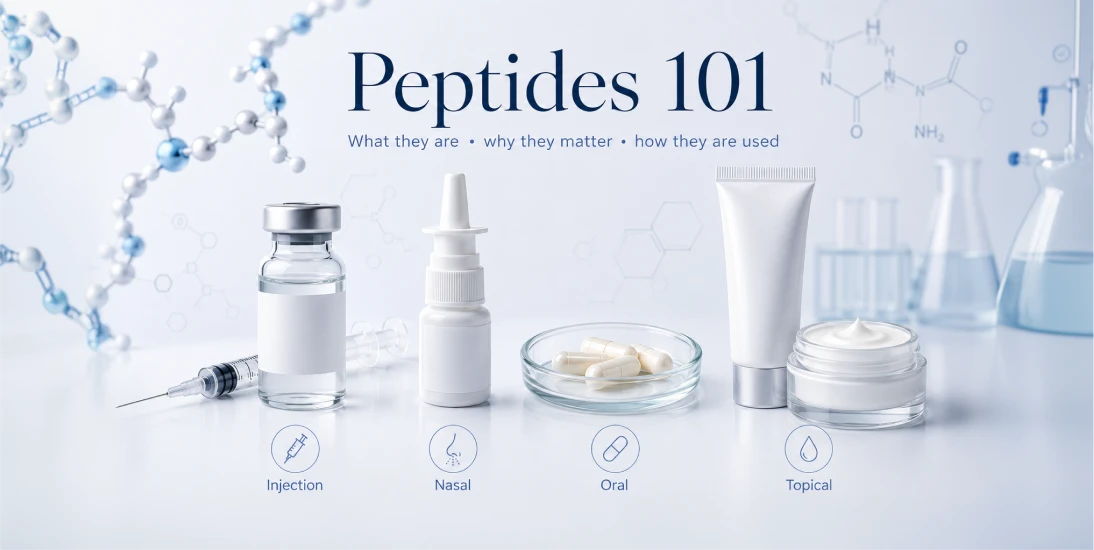
Some come from human biology. Some were discovered in animal research. Some are synthetic analogs inspired by natural signals. The final peptide used in research or clinical settings is usually made in a laboratory through peptide synthesis, then prepared in specific forms such as injections, nasal sprays, oral capsules, or topical creams.
Here are a few examples:
| Peptide | Origin or Inspiration | Main Area of Interest |
|---|---|---|
| Insulin | Naturally produced by the pancreas | Blood sugar regulation |
| GLP-1 | Naturally produced in the gut; some drug development was inspired by Gila monster venom research | Appetite, glucose, weight management |
| BPC-157 | Synthetic peptide inspired by compounds studied in gastric juice | Gut lining, tissue repair, inflammation research |
| GHK-Cu | Naturally occurring copper peptide found in human plasma, saliva, and urine | Skin, collagen, tissue repair, healthy aging research |
| Thymosin Alpha-1 | Naturally occurring peptide associated with the thymus | Immune modulation research |
TB-500 / Thymosin Beta-4 related peptides | Inspired by thymosin beta-4, a peptide involved in cell migration and tissue repair | Recovery, tissue repair research |
MOTS-c | Mitochondria-derived peptide | Energy metabolism, insulin sensitivity, aging research |
SS-31 / Elamipretide | Synthetic mitochondria-targeted peptide | Mitochondrial function and oxidative stress research |
GHK-Cu is a good example of an endogenous peptide: it naturally occurs in the body and has been studied for skin regeneration and wound-healing biology (PMC). MOTS-c is another fascinating example because it is encoded by mitochondrial DNA and is studied for its relationship with stress response, metabolism, insulin resistance, inflammation, and aging (PMC).
Why Did Peptides Become So Popular?
Peptides became popular for a few reasons.
First, GLP-1 medications changed the weight loss and metabolic health conversation. People started understanding that appetite, cravings, blood sugar, and body composition are not only about willpower. They are also controlled by hormones and signaling molecules.
Second, people are looking for more personalized approaches to health. Many are not only asking, “How do I lose weight?” They are asking, “How do I improve inflammation, energy, recovery, skin, hormones, muscle, gut health, and longevity?”
Third, educators and clinicians in the peptide space, including people like Dr. William Seeds, SSRP Institute, and conversations in the functional and performance medicine world, have helped bring more attention to cellular medicine and peptide signaling. At the same time, popular voices such as Andrew Huberman have also discussed peptides publicly, which increased curiosity but also created a need for better education.
And this is where we need balance: peptides are promising, but they are not magic. Some have strong clinical data and FDA-approved uses. Others are still mostly supported by animal studies, mechanisms, early clinical work, or practitioner experience.
How Are Peptides Used?
Peptides can be used in different forms, depending on their structure and purpose.
Injectable peptides are common because many peptides are fragile and can be broken down in digestion. Subcutaneous injections are often used for systemic effects.
Nasal sprays may be used for certain peptides that are designed for intranasal absorption, especially when the target is neurological or central signaling.
Oral peptides are more limited because stomach acid and digestive enzymes break down many peptides. Some peptides are specifically designed or stable enough for oral use.
Topical peptides are commonly used in skincare, especially peptides like GHK-Cu and cosmetic peptides that support skin signaling.
The route matters. A peptide can be excellent in one form and poorly absorbed in another. This is one reason professional guidance is so important.
Quality Matters: Source, Purity, and Testing
One of the biggest concerns with peptides is sourcing.
People can find peptides online, sometimes labeled “for research use only,” but that does not mean they are safe, clean, sterile, correctly dosed, or appropriate for human use. The FDA has warned that some products containing semaglutide, tirzepatide, or retatrutide have been sold directly to consumers while falsely labeled “for research purposes” or “not for human consumption” (FDA).
When evaluating peptide quality, the source should provide:
| Quality Factor |
| Certificate of Analysis |
| Sterility testing |
| Endotoxin testing |
| Heavy metal testing |
| Accurate concentration |
| Licensed pharmacy or regulated source |
| Why It Matters |
| Confirms identity and purity testing |
| Especially important for injectables |
| Helps reduce risk of inflammatory reactions |
| Screens for toxic contamination |
| Reduces risk of underdosing or overdosing |
| Helps protect quality and accountability |
The FDA also explains that compounded drugs are not FDA-approved and are not reviewed by FDA for safety, effectiveness, or quality before marketing. This does not mean all compounded products are “bad,” but it does mean quality, oversight, and medical need matter.
Common Peptides People Ask About
GLP-1 peptides: semaglutide, liraglutide, tirzepatide
These are among the best-known peptide-based medications. They are used in specific medical contexts for type 2 diabetes, obesity, and weight-related metabolic conditions. They work by influencing appetite, satiety, glucose regulation, and gastric emptying.
BPC-157
Often discussed for gut health, inflammation, tendon/ligament repair, and injury recovery. The scientific interest is strong, but human clinical data is still limited. It should not be presented as a guaranteed healing peptide.
GHK-Cu
A copper-binding peptide studied for skin health, collagen support, wound healing, hair, and tissue remodeling. It is one of the more familiar peptides in both skincare and regenerative wellness conversations.
Thymosin Alpha-1
A peptide associated with immune modulation. It has been studied in infection, immune function, and inflammatory states. A review describes thymosin alpha-1 as a naturally occurring thymic peptide recognized for immune-modulating properties (PubMed).
TB-500 / Thymosin Beta-4 related peptides
Often discussed for tissue repair, recovery, angiogenesis, and cellular migration. It is important to understand that commercial “TB-500” and full thymosin beta-4 are not always the same molecule.
MOTS-c
A mitochondrial-derived peptide studied for energy metabolism, stress adaptation, insulin sensitivity, inflammation, and aging biology.
SS-31 / Elamipretide
A mitochondria-targeted peptide studied for mitochondrial dysfunction, oxidative stress, ATP production, and conditions related to impaired cellular energy (PubMed).
CJC-1295 / Ipamorelin
Peptides that influence growth hormone signaling. They are commonly discussed for recovery, sleep, body composition, and muscle support, but they require careful evaluation because growth hormone pathways can affect glucose, insulin sensitivity, water retention, and other systems.
Do People React to Peptides?
Yes. Some people can react to peptides.
Reactions may include redness, swelling, irritation, bruising, nausea, headaches, fatigue, flushing, changes in appetite, sleep changes, water retention, or immune-type reactions. Reactions can happen because of the peptide itself, the dose, the route, the person’s health status, improper reconstitution, poor-quality sourcing, contaminants, or stacking too many compounds together.
This is why peptides should not be treated casually.
The Most Important Point
Peptides are tools, not trends.
The best peptide is not the one everyone is talking about online. The best peptide, if appropriate, is the one that matches the person’s health history, labs, goals, symptoms, risk factors, and current physiology.
Peptides should be used only with proper education, quality sourcing, and guidance from a qualified professional who understands peptide mechanisms, contraindications, medication interactions, dosing principles, side effects, and monitoring.
Educational Disclosure
This material is for educational purposes only and is not medical advice. Peptides vary widely in legal status, FDA approval, compounding availability, research status, quality standards, and clinical evidence. Some peptides are FDA-approved medications for specific conditions, while others remain investigational, compounded, or sold for research use only. Regulations can change, so always verify current status with a licensed healthcare professional and appropriate regulatory source before use.
This article does not sell, prescribe, or recommend any peptide product. The goal is education only.
In future articles, I will break down specific peptide categories in more detail, including peptides for metabolic health, gut support, tissue repair, skin health, mitochondrial function, immune balance, and healthy aging.
Sources / References for Peptide Blog
1. Basic definition of peptides
This source explains peptides in simple scientific language: peptides are short chains of amino acids connected by peptide bonds. It is useful for the opening section: “What are peptides?”
National Human Genome Research Institute. “Peptide.” NHGRI Genetics Glossary.
Website: https://www.genome.gov/genetics-glossary/Peptide
2. Amino acids as building blocks
This source explains amino acids and their role as building blocks for proteins and peptides. It is helpful when explaining peptides to readers who do not know what amino acids are.
Lopez, M. J., & Mohiuddin, S. S. “Biochemistry, Essential Amino Acids.” StatPearls. NCBI Bookshelf.
Website: https://www.ncbi.nlm.nih.gov/books/NBK557845/
3. Peptides as therapeutic tools
This review explains why peptides are important in modern medicine, including their use in metabolic disease, cancer, infectious disease, and other clinical areas. Use this for the section: “Why peptides matter in health and medicine.”
Wang, L., Wang, N., Zhang, W., et al. “Therapeutic peptides: current applications and future directions.” Signal Transduction and Targeted Therapy, 2022.
Website: https://www.nature.com/articles/s41392-022-00904-4
PMC: https://pmc.ncbi.nlm.nih.gov/articles/PMC8844085/
4. Peptide discovery, synthesis, and clinical applications
This newer review covers how therapeutic peptides are discovered, synthesized, optimized, and used clinically. It is useful for explaining that many peptides are designed or modified in laboratories for stability, absorption, or receptor activity.
Zheng, B., et al. “Therapeutic Peptides: Recent Advances in Discovery, Synthesis, and Clinical Applications.” 2025.
Website: https://pmc.ncbi.nlm.nih.gov/articles/PMC12154100/
5. How peptides are made in the lab
This source explains solid-phase peptide synthesis, one of the major methods used to create peptides by assembling amino acids step by step. Use this for the section explaining how peptides can come from natural inspiration but are usually synthesized in laboratories.
Mäde, V., Els-Heindl, S., & Beck-Sickinger, A. G. “Automated solid-phase peptide synthesis to obtain therapeutic peptides.” Beilstein Journal of Organic Chemistry, 2014.
Website: https://pmc.ncbi.nlm.nih.gov/articles/PMC4077397/
FDA / Regulatory Sources
6. Compounded drugs are not FDA-approved
This FDA page explains that compounded drugs are not FDA-approved, meaning FDA does not verify their safety, effectiveness, or quality before they are marketed. Use this in the quality and safety section.
U.S. Food and Drug Administration. “Compounding and the FDA: Questions and Answers.” Updated September 16, 2025.
Website: https://www.fda.gov/drugs/human-drug-compounding/compounding-and-fda-questions-and-answers
7. FDA concerns about unapproved GLP-1 products
This FDA page discusses unapproved GLP-1 products, including semaglutide, tirzepatide, and retatrutide products sold online or labeled “for research purposes” or “not for human consumption.” Use this for the warning about online peptide sourcing.
U.S. Food and Drug Administration. “FDA’s Concerns with Unapproved GLP-1 Drugs Used for Weight Loss.”
Website: https://www.fda.gov/drugs/drug-alerts-and-statements/fdas-concerns-unapproved-glp-1-drugs-used-weight-loss
8. FDA bulk substances and compounding rules
This FDA page explains how bulk drug substances are evaluated for use in compounding under section 503A of the FD&C Act. Use this when discussing that peptide legality and compounding status can vary and may change over time.
U.S. Food and Drug Administration. “Bulk Drug Substances Used in Compounding Under Section 503A of the FD&C Act.” Updated May 14, 2026.
Website: https://www.fda.gov/drugs/human-drug-compounding/bulk-drug-substances-used-compounding-under-section-503a-fdc-act
9. FDA clarification on GLP-1 compounding and shortages
This source is useful because GLP-1 compounding rules have changed as drug shortages changed. It supports your statement that FDA status can change and should always be verified with current sources.
U.S. Food and Drug Administration. “FDA clarifies policies for compounders as national GLP-1 supply begins to stabilize.” Updated April 1, 2026.
Website: https://www.fda.gov/drugs/drug-alerts-and-statements/fda-clarifies-policies-compounders-national-glp-1-supply-begins-stabilize
GLP-1 / Gila Monster Origin
10. Exenatide and the Gila monster origin
This source explains that exenatide is synthetic exendin-4, a peptide originally isolated from the salivary secretions of the Gila monster. Use this to correct the common misconception about Komodo dragon origin.
Eng, J., et al. “Discovery and development of exenatide.” Current Diabetes Reviews, 2012.
Website: https://pubmed.ncbi.nlm.nih.gov/23231438/
11. GLP-1 analogues and exendin-4
This paper explains that Gila monster saliva contains exendin-4, a structural analogue of human GLP-1 with a longer half-life. Use this when explaining how nature-inspired discoveries can become synthetic drugs.
Deane, A. M., et al. “The use of glucagon-like peptide-1 analogues in the critically ill.” Critical Care, 2010.
Website: https://pmc.ncbi.nlm.nih.gov/articles/PMC3219279/
12. Educational background on Gila monster venom and diabetes drugs
This is a more reader-friendly source from VA Research about how Gila monster research contributed to diabetes drug development. Use it for a simple explanation in the blog.
U.S. Department of Veterans Affairs Research. “Diabetes drug from Gila monster venom.”
Website: https://www.research.va.gov/research_in_action/Diabetes-drug-from-Gila-monster-venom.cfm
BPC-157
13. BPC-157 and gastric peptide research
This source discusses BPC-157 as a stable gastric pentadecapeptide studied in cytoprotection, tissue repair, and stress-response models. Use this for explaining the stomach/gastric origin concept, while keeping claims conservative.
Sikiric, P., et al. “Stable Gastric Pentadecapeptide BPC 157, Robert’s Stomach Cytoprotection/Adaptive Cytoprotection/Organoprotection, and Selye’s Stress Coping Response.” Current Pharmaceutical Design, 2019.
Website: https://pmc.ncbi.nlm.nih.gov/articles/PMC7096228/
14. BPC-157 and wound-healing research
This review focuses on BPC-157 and wound-healing biology, mostly in experimental and preclinical models. Use this to avoid overclaiming and to say human evidence remains limited.
Seiwerth, S., et al. “Stable Gastric Pentadecapeptide BPC 157 and Wound Healing.” Frontiers in Pharmacology, 2021.
Website: https://www.frontiersin.org/articles/10.3389/fphar.2021.627533/full
GHK-Cu / Copper Peptide
15. GHK-Cu as a natural human peptide
This source explains that GHK is naturally found in human plasma, saliva, and urine and functions as a copper-binding peptide involved in skin repair, wound healing, and tissue remodeling. Use this for the “beauty peptide” section.
Pickart, L., & Margolina, A. “GHK Peptide as a Natural Modulator of Multiple Cellular Pathways in Skin Regeneration.” BioMed Research International, 2015.
Website: https://pmc.ncbi.nlm.nih.gov/articles/PMC4508379/
16. GHK-Cu and anti-aging skin research
This source reviews GHK-Cu in skin remodeling, wound healing, antioxidant activity, and anti-inflammatory pathways. Use this for skin, collagen, and healthy-aging discussions.
Dou, Y., et al. “The potential of GHK as an anti-aging peptide.” 2020.
Website: https://pmc.ncbi.nlm.nih.gov/articles/PMC8789089/
Thymosin Alpha-1
17. Thymosin Alpha-1 and immune modulation
This comprehensive review explains that thymosin alpha-1 is a peptide naturally occurring in the thymus and is recognized for immune-modulating properties. Use this for immune-support discussion, without making disease-treatment claims.
Dominari, A., et al. “Thymosin alpha 1: A comprehensive review of the literature.” World Journal of Virology, 2020.
Website: https://pmc.ncbi.nlm.nih.gov/articles/PMC7747025/
18. Thymosin Alpha-1 biological activity
This paper discusses thymosin alpha-1’s effects on immune cells, cytokines, and immune regulation. Use this when explaining mechanism of action.
Li, J., et al. “Thymosin alpha 1: biological activities, applications and genetic engineering production.” Peptides, 2010.
Website: https://pmc.ncbi.nlm.nih.gov/articles/PMC7115394/
MOTS-c / Mitochondrial Peptides
19. MOTS-c and metabolic homeostasis
This is one of the key foundational papers on MOTS-c. It describes MOTS-c as a mitochondrial-derived peptide studied for metabolic homeostasis, insulin resistance, and obesity in preclinical models.
Lee, C., Zeng, J., Drew, B. G., et al. “The mitochondrial-derived peptide MOTS-c promotes metabolic homeostasis and reduces obesity and insulin resistance.” Cell Metabolism, 2015.
Website: https://pmc.ncbi.nlm.nih.gov/articles/PMC4350682/
20. MOTS-c review
This review summarizes MOTS-c research in mitochondrial biology, metabolism, insulin resistance, inflammation, and aging. Use this for a broader explanation of mitochondrial peptides.
Zheng, Y., et al. “MOTS-c: A promising mitochondrial-derived peptide for therapeutic exploitation.” 2023.
Website: https://pmc.ncbi.nlm.nih.gov/articles/PMC9905433/
21. MOTS-c, diabetes, and aging-related disease
This source reviews MOTS-c in diabetes, insulin sensitivity, and aging-related disease research. Use this for metabolic health and longevity sections.
Kong, B. S., Lee, C., & Cho, Y. M. “Mitochondrial-Encoded Peptide MOTS-c, Diabetes, and Aging-Related Diseases.” Diabetes & Metabolism Journal, 2023.
Website: https://www.e-dmj.org/journal/view.php?number=2725
SS-31 / Elamipretide
22. SS-31 / Elamipretide mechanism
This review explains SS-31, also known as elamipretide, and its mitochondrial mechanism, including cardiolipin stabilization, oxidative stress, and mitochondrial function. Use this for mitochondrial-energy discussions.
Tung, C., et al. “Elamipretide: A Review of Its Structure, Mechanism of Action, and Therapeutic Potential.” 2025.
Website: https://pmc.ncbi.nlm.nih.gov/articles/PMC11816484/
23. SS-31 and mitochondria-targeting research
This source discusses SS-31 as a mitochondria-targeting peptide that binds cardiolipin and supports mitochondrial function in experimental models.
Zhu, Y., et al. “SS-31, a Mitochondria-Targeting Peptide, Ameliorates Kidney Injury.” 2022.
Website: https://pmc.ncbi.nlm.nih.gov/articles/PMC9192202/
Peptide safety, popularity, and public education
24. Huberman Lab peptide overview
This is a public educational podcast/page discussing peptide categories, possible benefits, risks, sourcing, cycling, routes of use, and the importance of medical supervision. Use it carefully as an educational source, not as a primary scientific reference.
Huberman Lab. “Benefits & Risks of Peptide Therapeutics for Physical & Mental Health.”
Website: https://www.hubermanlab.com/episode/benefits-risks-of-peptide-therapeutics-for-physical-mental-health
25. SSRP Institute peptide education
This source represents professional peptide education and certification. Use it to mention practitioner education and the importance of training in peptide protocols.
SSRP Institute. “Peptide Therapy Certification.”
Website: https://ssrpinstitute.org/
26. Dr. William Seeds peptide education
This is a practitioner-oriented peptide education book often referenced in the peptide therapy space. Use it as an educational/practitioner reference, not as primary clinical evidence.
Seeds, William A. Peptide Protocols: Volume One.
Website: https://www.amazon.com/Peptide-Protocols-William-Seeds-MD/dp/0578624354
Suggested disclaimer source support
27. Use this source to support your disclaimer about changing FDA status
This FDA source is useful because it shows that FDA guidance around GLP-1 compounding has changed with supply status, reinforcing your blog disclaimer that peptide rules and availability may change.
U.S. Food and Drug Administration. “FDA clarifies policies for compounders as national GLP-1 supply begins to stabilize.”
Website: https://www.fda.gov/drugs/drug-alerts-and-statements/fda-clarifies-policies-compounders-national-glp-1-supply-begins-stabilize
28. Use this source to support your quality/sourcing warning
This FDA source supports the statement that unapproved peptide or GLP-1 products sold online may be mislabeled, illegally marketed, or sold as “research” products despite intended human use.
U.S. Food and Drug Administration. “FDA’s Concerns with Unapproved GLP-1 Drugs Used for Weight Loss.”
Website: https://www.fda.gov/drugs/drug-alerts-and-statements/fdas-concerns-unapproved-glp-1-drugs-used-weight-loss