
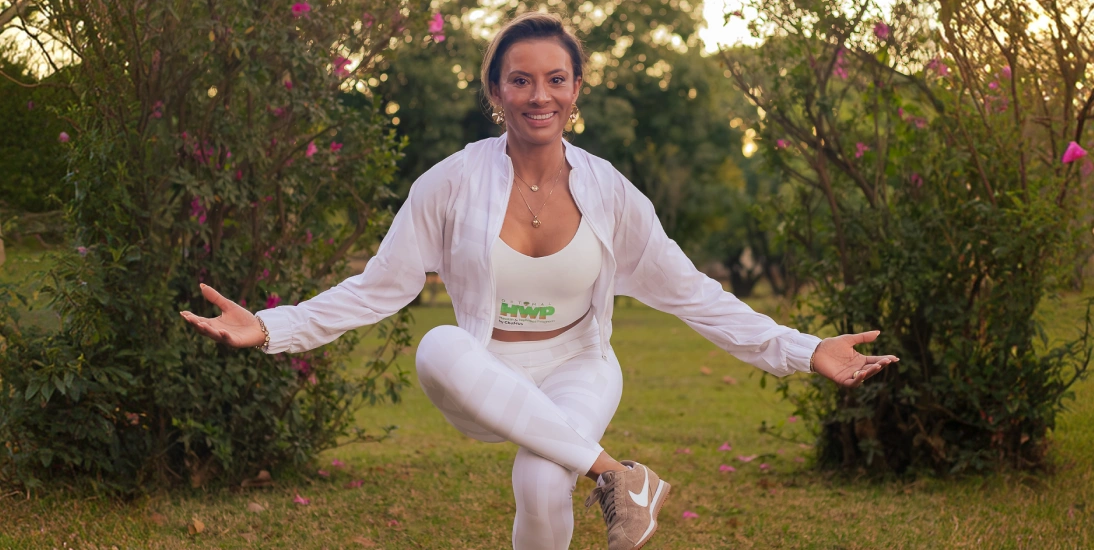

Can you keep your balance?
Can you stand on one leg?
Can you get up from a chair without using your hands?
Can you recover quickly if you trip?
Can you walk confidently over grass, sand or an uneven surface?
Can you climb stairs without feeling unstable?
These may sound like very simple abilities, but they tell us a lot about our muscle strength, mobility, coordination, nervous system, proprioception and physical independence.
And as we get older, losing these abilities can have serious consequences.
Aging well is not just about adding years to our life.
It is about maintaining the physical ability to move, react, walk, travel, climb stairs, get off the floor and live independently for as long as possible.
And balance is a major part of that.
Balance Is Much More Than Standing Still
When people say someone has “bad balance,” it can sound like one isolated problem.
It isn’t.
Our ability to stay upright depends on several systems working together every second.
Your eyes tell your brain where your body is in relation to the environment.
Your vestibular system, located in the inner ear, helps your brain understand movement, acceleration and the position of your head.
Your feet, muscles, tendons and joints constantly send information to the nervous system about where your body is positioned.
Your brain receives and interprets all of those signals.
And finally, your muscles need to react quickly enough to make the necessary correction.
This awareness of where the body is positioned in space is called proprioception.
Think about walking on an uneven sidewalk.
Your foot lands slightly differently than expected.
Almost instantly, sensory receptors send that information to your nervous system.
Your ankle adjusts.
Your leg muscles contract.
Your hips stabilize.
Your core responds.
You continue walking without even thinking about it.
That entire sequence can happen in a fraction of a second.
When we are younger and physically strong, our body is usually very good at making these corrections.
As we age, however, several parts of this system can begin to deteriorate.
And that is when a small misstep can become a fall.
Why Does Balance Get Worse with Age?
There is rarely only one reason.
Balance can decline because of a combination of:
- Loss of muscle strength
- Sarcopenia
- Physical inactivity
- Reduced ankle and hip mobility
- Changes in vision
- Vestibular problems
- Neuropathy or decreased sensation in the feet
- Arthritis and joint pain
- Neurological conditions
- Certain medications
- Reduced reaction time
- Fear of falling
- Spending too much time sitting
- Lack of challenging movement
- Previous falls or injuries
And there is another very important factor:
We stop practicing balance.
Many adults live in very controlled environments.
Flat floors.
Supportive shoes.
Cars.
Elevators.
Escalators.
Chairs.
Very little climbing.
Very little squatting.
Very few uneven surfaces.
Very little movement that actually challenges the nervous system.
Our bodies adapt to what we ask them to do.
And they also gradually lose abilities that we stop using.
Sarcopenia: One of the Biggest Pieces of the Puzzle
One of the most important factors affecting balance as we age is sarcopenia.
Sarcopenia is the progressive loss of skeletal muscle mass, strength and physical function that occurs with aging.
And this is something I talk about constantly because muscle is not just about appearance.
We need to stop thinking about muscle simply as:
“I want toned arms.”
or
“I want stronger legs.”
Muscle is an organ of longevity.
It helps regulate glucose.
It contributes to metabolic health.
It protects our joints.
It supports our bones.
It allows us to move.
And, extremely importantly, muscle gives us the ability to catch ourselves when we lose our balance.
Imagine tripping over something.
A younger or stronger person may instantly extend a leg, activate the glutes, stabilize the hips and recover.
Someone with significant muscle weakness may not have the same capacity.
The difference between stumbling and falling can sometimes be the body’s ability to generate enough force quickly enough.
That is why muscle strength and fall prevention are so interconnected.
Dr. Gabrielle Lyon and the Importance of Muscle
Dr. Gabrielle Lyon has brought significant attention to what she calls Muscle-Centric Medicine.
Her philosophy emphasizes skeletal muscle as one of the most important tissues for metabolic health, physical function and longevity.
One of the central messages in her work is that we should not wait until old age to start worrying about muscle.
The goal should be to build and preserve muscle throughout adulthood so that we enter later life with a greater physical reserve.
I strongly agree with this idea.
The question should not only be:
“How much muscle do I have today?”
It should also be:
“How much muscle will I have available when I am 70, 80 or 90?”
Because the stronger you enter older age, the more reserve you have available as natural age-related losses occur.
Dr. Mark Hyman has also repeatedly emphasized resistance training, protein intake and the preservation of muscle as fundamental components of healthy aging.
And this is consistent with the scientific literature.
Research involving older adults with sarcopenia consistently supports resistance exercise as one of the primary strategies for improving strength and physical function.
When resistance exercise is combined with balance and functional training, the benefits become even more relevant for fall prevention.
Falls Are a Major Public Health Problem
Falls should not be dismissed as simply something that happens because someone is “getting old.”
According to the CDC, more than one in four adults aged 65 and older reports falling each year in the United States.
Millions of older adults are treated for fall-related injuries.
And falls are one of the major causes of injury-related loss of independence in older people.
Sometimes the initial event sounds almost insignificant.
Someone misses a step.
Trips over a rug.
Slips getting out of the shower.
Loses balance when getting dressed.
Steps incorrectly off a curb.
Gets up too quickly during the night.
But the consequences can be enormous.
Especially when a hip fracture occurs.
What Happens After a Hip Fracture?
There is a statistic commonly repeated online that says:
“Half of older adults who fall and break a bone never walk again.”
That statement is too broad and is not scientifically accurate for every type of fracture.
The research is more specifically concerning hip fractures.
And unfortunately, the real research is still very concerning.
Studies examining recovery after hip fracture have found that only approximately 40–60% of survivors may regain their previous level of mobility within the following year, depending on the population studied and how recovery is defined.
Some studies report even lower recovery of pre-fracture mobility.
Hip fractures are also associated with a significant increase in mortality during the following months and year.
But it is important to understand something:
People usually don’t die simply because a bone broke.
The fracture can begin a much larger cascade.
The cascade may look something like this:
Fall
↓
Hip fracture
↓
Hospitalization and surgery
↓
Reduced movement
↓
Rapid muscle loss
↓
Greater weakness
↓
Difficulty walking
↓
Loss of independence
↓
Higher risk of another fall
↓
Greater risk of infections, blood clots, cardiovascular complications and other health problems
This is why fall prevention is so important.
We don’t want to wait until someone has already fallen to start thinking about strength and balance.
Balance Is a Skill—and Skills Need Practice
One of the most important things I want people to understand is:
Balance can be trained.
Just like strength.
Just like cardiovascular conditioning.
Just like flexibility.
Research strongly supports exercise for fall prevention.
Large systematic reviews have found that appropriately designed exercise programs can reduce fall rates among older adults.
Programs that include balance exercises and functional training, particularly when combined with resistance training, appear to be particularly beneficial.
This is extremely important because many people believe:
“I walk every day, so I’m doing enough.”
Walking is excellent.
Please walk.
But walking and strength training do not produce exactly the same adaptations.
And walking along a perfectly flat surface does not necessarily challenge balance enough to maintain all of the skills needed to prevent falls.
For healthy aging, we need different types of movement.
We need:
Walking for endurance.
Resistance training for muscle.
Balance training for postural control.
Functional movement for everyday independence.
And ideally, some movements that safely challenge coordination and reaction time.
What About Walking Barefoot?
This is an area I find particularly interesting.
Our feet contain an enormous amount of sensory information.
The soles of the feet help tell our nervous system:
Where is the ground?
Is it hard?
Soft?
Uneven?
Sloped?
Stable?
Changing?
Many of us, however, spend almost every waking hour wearing shoes.
We walk from the bedroom to the car.
From the car into an office.
From an office back to the car.
And often exercise wearing thick, highly supportive athletic shoes.
This means the feet may experience relatively little sensory variety.
Research examining barefoot exercise and plantar sensory stimulation suggests that stimulating the soles of the feet and training foot function may contribute to improvements in postural control and balance.
For example, small randomized studies in older adults have reported improvements in plantar sensitivity and some measures of balance when exercise was performed barefoot.
Other research suggests that strengthening the intrinsic muscles of the feet may contribute to postural stability.
But we need to be precise with the science.
We cannot say that wearing shoes causes loss of balance.
And we cannot say that walking barefoot alone will prevent falls.
The strongest evidence for fall prevention continues to support structured balance, functional and resistance exercise.
Barefoot activity can be an additional tool.
Why I Like Safe Barefoot Walking on Different Surfaces
For a healthy person who can safely walk barefoot, I like the concept of occasionally exposing the feet to different surfaces.
For example:
- A safe indoor floor
- Grass
- Firm sand
- Different safe textures
Why?
Because every surface provides slightly different sensory information.
When you walk over grass, your feet and ankles make tiny adjustments.
When you walk over sand, the ground changes underneath you.
Your feet, ankles, legs, hips and nervous system all have to react.
I see this as a type of sensory and proprioceptive training.
However, more difficult is not automatically better.
Deep or unstable sand can dramatically increase the balance challenge.
Someone who is already unstable should not go walk alone barefoot on uneven ground thinking that they are “training balance.”
Safety always comes first.
Who Should Be Careful with Barefoot Training?
Barefoot walking is not appropriate for everyone.
People with:
- Diabetic neuropathy
- Significant loss of sensation in the feet
- Open wounds
- Foot ulcers
- Severe peripheral vascular disease
- Severe balance impairment
- Significant foot deformities
- High fall risk
should be particularly careful and may need medical or rehabilitation guidance before attempting barefoot exercises.
You do not improve longevity by creating an unnecessary fall.
Progress gradually.
Simple Exercises to Protect Your Balance as You Age
You don’t need complicated machines to start.
Some of the most useful exercises are incredibly simple.
The important thing is to practice them consistently and progress safely.
1. Sit-to-Stand
Use a sturdy chair.
Sit normally.
Place your feet firmly on the floor.
Stand up.
Then lower yourself back into the chair slowly and with control.
If possible, try not to push yourself up with your hands.
Start with:
8–12 repetitions
Why do I love this exercise?
Because being able to get out of a chair independently is one of the most important functional abilities we have.
It strengthens the:
- Quadriceps
- Glutes
- Hips
- Core
And it practices an activity we perform every single day.
2. Single-Leg Balance
Stand near a countertop or sturdy chair.
Hold the surface if necessary.
Lift one foot slightly off the ground.
Try holding:
10 seconds
Eventually work toward:
20–30 seconds
Then repeat on the opposite side.
As your balance improves, gradually reduce how much you hold onto the support.
Do not close your eyes or make the exercise more difficult until you are completely comfortable and safe with the easier version.
3. Heel-to-Toe Walking
Think about walking along an imaginary straight line.
Place the heel of your front foot close to the toes of your back foot.
Then continue forward slowly.
Try:
10–20 steps
Do this next to a wall or stable surface when you are beginning.
This narrows your base of support and challenges balance more than regular walking.
4. Calf Raises
Stand behind a stable chair or countertop.
Raise your heels slowly.
Come onto your toes.
Hold briefly.
Lower yourself slowly.
Perform:
10–15 repetitions
The calves and ankles play an important role in balance and gait.
Strong ankles help us make those small corrections necessary when our center of gravity changes.
5. Step-Ups
Use a low, stable step.
Place one foot on the step.
Step up.
Slowly step back down.
Alternate legs.
This strengthens the legs and practices something essential for daily life:
stairs and changes in elevation.
6. Practice Getting Up from the Floor
For someone physically capable of doing so safely, getting up and down from the floor is an incredibly valuable functional skill.
Start with support.
Use a couch or sturdy piece of furniture.
Learn how to move from:
Floor → kneeling → half-kneeling → standing.
If getting onto the floor is difficult or unsafe, work with a physical therapist or qualified exercise professional first.
The goal is not to prove anything.
The goal is to preserve independence.
7. Train Your Feet
Your foot contains many small muscles.
And like every muscle, those muscles need to work.
Try:
Toe spreading
Spread the toes apart.
Relax.
Repeat.
Toe control
Try lifting the big toe while keeping the other toes down.
Then reverse.
Short-foot exercise
Without curling the toes, gently draw the ball of the foot toward the heel.
You should feel the arch activate slightly.
These exercises may look insignificant.
They are not.
Your feet are literally your connection with the ground.
8. Safe Barefoot Sensory Practice
If it is safe for you, spend a few minutes barefoot.
Start inside your home on a clean, predictable surface.
Pay attention to how the ground feels underneath the feet.
Later, a healthy person may progress to a safe area of grass.
Then perhaps firm sand.
You don’t need an hour.
Even a few minutes of deliberate sensory exposure can make the feet work differently from being inside shoes all day.
Again, think of this as a supplement to balance and strength training, not a replacement for them.
9. Strength Training
If I had to choose one physical intervention that people should not abandon as they age, strength training would be very high on my list.
Ideally, exercise the major muscle groups.
Focus particularly on maintaining strength in the:
- Quadriceps
- Hamstrings
- Glutes
- Calves
- Back
- Core
- Upper body
You don’t necessarily need extremely heavy weights.
Machines, dumbbells, resistance bands and body-weight exercises can all be useful depending on your ability.
But the muscles need enough resistance to receive a reason to adapt.
Challenge produces adaptation.
Don’t Forget Protein
I don’t want to turn this into an article about nutrition because that is a completely separate topic.
But we cannot talk about muscle and sarcopenia without briefly talking about protein.
Strength training sends the signal:
“We need this muscle.”
Protein provides the amino acids that help the body maintain and rebuild it.
This becomes increasingly important with age because older adults can develop what researchers call anabolic resistance.
In simple terms, older muscle may not respond as strongly to the same amount of protein and exercise as younger muscle does.
That means adequate protein intake becomes even more important.
Expert recommendations commonly suggest approximately 1.0–1.2 grams of protein per kilogram of body weight per day for healthy older adults, with higher amounts sometimes appropriate for physically active adults or certain clinical circumstances.
Individual needs vary.
Kidney disease and some other medical conditions may require individualized recommendations.
But the basic message is simple:
Do not exercise to preserve muscle while chronically under-eating protein.
Don’t Wait Until You’re 70 to Think About This
This may be one of the biggest mistakes we make.
People hear the words:
Falls. Sarcopenia. Loss of mobility.
And immediately think:
“That’s something I will worry about when I’m old.”
No.
The muscle and physical reserve you have later in life are influenced by what you are doing now.
If you’re 40, this matters.
If you’re 50, this matters.
If you’re 60, this matters.
And if you’re 70 or 80, it is still worth working on.
It is almost never too late to improve physical function.
But prevention gives us an enormous advantage.
Test Yourself
Here are a few simple questions.
Can you:
- Stand from a chair without pushing yourself up with your hands?
- Balance on one leg for 10 seconds?
- Walk confidently up and down stairs?
- Walk across uneven grass?
- Rise onto your toes repeatedly?
- Get yourself off the floor?
- Walk while turning your head without becoming unstable?
- Recover your balance quickly after a small misstep?
If some of these are becoming difficult, don’t ignore them.
Think of them as information.
Your body may be telling you:
This is something I need to train.
The Goal Isn’t Just Living Longer
I talk a lot about longevity.
But longevity without function is not enough.
Imagine living to 90.
There is a huge difference between reaching 90 able to walk, travel, cook, dress yourself, meet friends and remain independent…
and reaching the same age unable to perform basic activities without assistance.
That difference is what we call healthspan.
How many of your years are lived with health, mobility and independence?
Muscle matters.
Strength matters.
Balance matters.
Your feet matter.
Movement matters.
And the earlier you start protecting these abilities, the more physical reserve you can carry with you into the future.
Final Thoughts
Balance is not something we should take for granted or wait to address after a fall. It reflects the strength, coordination, mobility and sensory awareness that help us remain independent as we age.
The good news is that these abilities can be trained. Regular strength exercises, balance practice, adequate protein and safe movement can help build the physical reserve needed for everyday life.
Start where you are, progress gradually and prioritize safety. Your future self will benefit from every step, repetition and moment of practice you invest today.
Sources & References
- CDC — Older Adult Falls Data
https://www.cdc.gov/falls/data-research/index.html - CDC — Preventing Falls and Hip Fractures
https://www.cdc.gov/falls/prevention/index.html - World Health Organization — Falls
https://www.who.int/news-room/fact-sheets/detail/falls - World Health Organization — Step Safely: Strategies for Preventing and Managing Falls Across the Life-Course
https://www.who.int/publications/i/item/978924002191-4 - Sherrington C, et al. Exercise for preventing falls in older people living in the community. Cochrane Database of Systematic Reviews.
https://doi.org/10.1002/14651858.CD012424.pub2 - Peeters G, van Schoor NM, Lips P. A critical review of the long-term disability outcomes following hip fracture. BMC Geriatrics. 2016.
https://pmc.ncbi.nlm.nih.gov/articles/PMC5010762/ - Tang VL, et al. Rates of Recovery to Pre-Fracture Function in Older Persons with Hip Fracture. Journal of General Internal Medicine. 2017.
https://pmc.ncbi.nlm.nih.gov/articles/PMC5264672/ - Shen Y, et al. Exercise for sarcopenia in older people: A systematic review and network meta-analysis. Journal of Cachexia, Sarcopenia and Muscle. 2023.
https://pubmed.ncbi.nlm.nih.gov/37057640/ - Korchi K, et al. Optimization of the Effects of Physical Activity on Plantar Sensation and Postural Control With Barefoot Exercises in Institutionalized Older Adults. Journal of Aging and Physical Activity. 2019.
https://pubmed.ncbi.nlm.nih.gov/30676219/ - Hu X, Zeng Z, Wang L. Effects of an eight-week composite plantar sensory exercise on postural stability in older adults. Journal of Exercise Science & Fitness. 2026.
https://pmc.ncbi.nlm.nih.gov/articles/PMC12865565/ - Bauer J, et al. Evidence-Based Recommendations for Optimal Dietary Protein Intake in Older People: A Position Paper From the PROT-AGE Study Group. Journal of the American Medical Directors Association. 2013.
https://pubmed.ncbi.nlm.nih.gov/23867520/ - Dr. Gabrielle Lyon — Muscle-Centric Medicine
https://drgabriellelyon.com/muscle-centric-medicine/ - Dr. Gabrielle Lyon — Forever Strong
https://drgabriellelyon.com/forever-strong/ - Dr. Mark Hyman — Why Weight Training Is Key to Longevity & Fighting Chronic Disease
https://drhyman.com/blogs/content/podcast-ep951 - Dr. Mark Hyman — Muscle, Protein and Longevity
https://drhyman.com/blogs/content/podcast-ep1047