
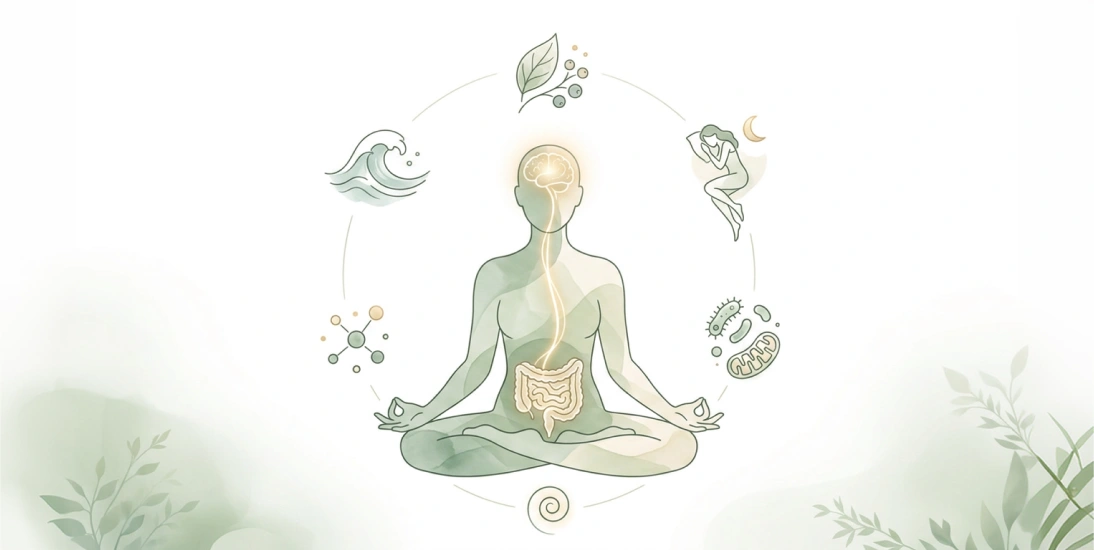



The gut, immune system, hormones, sleep rhythm, mitochondria, blood sugar, nutrient status, inflammation, and lifestyle all influence how the brain feels and functions.
This is why two people can have the same diagnosis but need completely different support.
One person may have anxiety driven by poor sleep and high cortisol.
Another may have depression connected to inflammation and gut dysfunction.
Another may have ADHD symptoms worsened by blood sugar crashes, low dopamine tone, nutrient deficiencies, or poor sleep.
So the better question is not only:
“What medication should this person take?”
The better question is:
“What is dysregulating this person’s nervous system?”
The Gut-Brain Connection
The gut is one of the most important places to look in anxiety, depression, and ADHD.
The gut microbiome helps regulate neurotransmitter metabolism and gut-to-brain signaling, and research connects gut microbiota changes with depression, anxiety, addiction, Parkinson’s disease, and other neuropsychiatric conditions.
Many neuroactive compounds are produced or influenced in the gut, including serotonin, GABA, dopamine, acetylcholine, histamine, and catecholamines.
Important note: the brain still produces many neurotransmitters locally. Gut-produced neurotransmitters do not simply “replace” brain neurotransmitters. But the gut can influence the brain through:
- The vagus nerve
- Inflammation
- Immune signaling
- Microbial metabolites
- Blood sugar regulation
- Nutrient absorption
- Tryptophan metabolism
- Gut permeability
- Histamine balance
This is why gut symptoms like bloating, constipation, diarrhea, reflux, food sensitivities, or chronic inflammation can show up emotionally as anxiety, low mood, poor focus, irritability, or fatigue.
Dr. Mark Hyman often frames mental health through a functional medicine lens: inflammation, poor diet, gut dysfunction, blood sugar imbalance, nutrient deficiencies, and microbiome disruption can all contribute to mental health symptoms.
Why Medication Alone Is Often Not the Full Solution
Antidepressants, anti-anxiety medications, and ADHD medications can be helpful. For some people, they are necessary, stabilizing, and even life-saving.
But they are not the whole solution when they are used without addressing the underlying biology.
Most medications work by changing neurotransmitter signaling. For example, many antidepressants increase serotonin availability. ADHD stimulants increase dopamine and norepinephrine signaling. This may improve symptoms, but it does not automatically correct why the system became dysregulated in the first place.
If the person still has gut inflammation, poor sleep, alcohol use, nutrient deficiencies, trauma, blood sugar instability, chronic stress, mitochondrial dysfunction, or hormonal imbalance, the root problem may continue underneath the medication.
Over time, medication-only care may also bring challenges such as:
- Emotional blunting
- Low libido or sexual dysfunction
- Sleep disruption
- Appetite changes
- Increased anxiety in sensitive people
- Dependency on symptom control without rebuilding biology
- Withdrawal symptoms if stopped too quickly
- Incomplete response or relapse
So the message is not “medication is bad.”
The message is: medication is not a root-cause protocol by itself.
Alcohol: A Hidden Driver of Anxiety and Depression
Alcohol is one of the biggest disruptors of mental health protocols.
Even when someone says, “I only drink socially,” alcohol can disrupt:
- Sleep quality
- REM sleep
- Cortisol rhythm
- Blood sugar
- Gut lining
- Microbiome balance
- Hormones
- Dopamine regulation
- Anxiety levels the next day
Andrew Huberman has discussed how alcohol affects stress pathways, dopamine, sleep, and mood, and his sleep tools emphasize light exposure, sleep timing, wind-down routines, caffeine timing, and reducing alcohol for better nervous system regulation.
For anxiety, depression, and ADHD, alcohol should be removed or strongly minimized.
How to Build a Real Protocol
A complete protocol should include food, gut support, nutrients, lifestyle, sleep, nervous system regulation, and peptides.
Peptides are not the protocol by themselves.
They are tools inside the protocol.
1. Food Foundation
The brain needs raw materials.
Focus on:
- High-quality protein at each meal
- Omega-3-rich foods
- Colorful vegetables
- Polyphenols: berries, herbs, cacao, olive oil, green tea
- Stable blood sugar meals
- Fermented foods if tolerated
- Gluten/dairy removal when sensitivity or inflammation is suspected
- No ultra-processed foods
- No artificial sweeteners if gut symptoms are present
2. Gut-Brain Repair
This is central.
Support:
- Regular bowel movements
- Gut lining integrity
- Microbiome diversity
- Histamine balance
- H. pylori, SIBO, dysbiosis, parasites, or yeast when clinically suspected
- Food sensitivity evaluation when symptoms suggest it
- Prebiotics, probiotics, digestive enzymes, DAO, glutamine, zinc carnosine, aloe, or other gut tools when appropriate
3. Nutrient Support
Mood and focus depend on nutrients.
Key nutrients to evaluate:
- Magnesium
- Zinc
- Vitamin D
- B6
- B12
- Folate / methylfolate
- Omega-3 index
- Iron/ferritin
- Amino acids
- Vitamin C
- Copper balance
- Thyroid markers
- Inflammatory markers
4. Sleep and Circadian Rhythm
No protocol works well if sleep is broken.
Support:
- Morning sunlight
- Consistent bedtime
- No screens late at night
- No alcohol
- Caffeine only early
- Blood sugar stability at night
- Magnesium glycinate or L-theanine if appropriate
- Melatonin only when needed and individualized
5. Nervous System Regulation
The nervous system must learn safety again.
Tools:
- Breathwork
- Walking
- Strength training
- Sauna or heat therapy if tolerated
- Meditation or prayer
- Therapy or trauma work
- Time outside
- Reduced overstimulation
- Healthy social connection
6. Peptide Support
Peptides can be selected based on the dominant pattern.
| Pattern | Peptide Consideration |
|---|---|
| Anxiety, overthinking, hypervigilance | Selank |
| ADHD, low focus, low motivation, brain fog | Semax |
| Stress-response dysregulation | Neuropeptide Y / NPY, more advanced and research-based |
| Poor sleep, circadian rhythm disruption | Epitalon |
| Emotional burnout, cognitive fatigue | Pinealon |
| Mitochondrial fatigue, low energy | MOTS-c or SS-31 |
| Gut inflammation / gut repair focus | BPC-157 or KPV, depending on case and clinical guidance |
| Immune/inflammatory imbalance | Thymosin alpha-1, depending on case |
Selank
Best for anxiety-dominant patterns.
Selank may be useful when the person feels:
- Anxious
- Emotionally reactive
- Overstimulated
- Socially anxious
- Stuck in stress mode
- “Wired but tired”
Simple explanation:
Selank is more calming and stress-regulating.
Semax
Best for cognitive and motivation patterns.
Semax may be useful when the person feels:
- Brain fog
- Low motivation
- Poor focus
- Mental fatigue
- Depression with cognitive slowing
- ADHD-like symptoms
Simple explanation:
Semax is more activating and focus-supportive.
For anxious people, Semax should be introduced carefully because it may feel too stimulating for some.
MOTS-c and SS-31
These are important when the person has depression with fatigue, low stamina, poor exercise tolerance, brain fog, or mitochondrial dysfunction.
MOTS-c is more metabolic and energy-signaling.
SS-31 is more mitochondrial membrane protection and ATP-efficiency focused.
Final Message
Anxiety, depression, and ADHD are not only brain problems. They are whole-body signals.
The gut, immune system, sleep rhythm, hormones, nutrients, mitochondria, and lifestyle all speak to the brain every day.
The most effective approach is not only to suppress symptoms.
It is to rebuild the body systems that allow the brain to feel calm, focused, motivated, and resilient.
Food is medicine. Sleep is medicine. Gut repair is medicine. Movement is medicine. Nutrients are medicine. Peptides can be powerful tools, but only when they are part of a complete root-cause protocol.
Sources:
- Qu S, Li Y, Wang X, et al. Gut microbiota modulates neurotransmitter and gut-brain signaling. PubMed, 2024.
https://pubmed.ncbi.nlm.nih.gov/39106786/ - Appleton J. The Gut-Brain Axis: Influence of Microbiota on Mood and Mental Health. Integrative Medicine, 2018.
https://pmc.ncbi.nlm.nih.gov/articles/PMC6469458/ - Mittal R, Debs LH, Patel AP, et al. Neurotransmitters: The Critical Modulators Regulating Gut-Brain Axis. Journal of Cellular Physiology, 2017.
https://pmc.ncbi.nlm.nih.gov/articles/PMC5772764/ - Dicks LMT. Gut Bacteria and Neurotransmitters. Microorganisms, 2022.
https://pubmed.ncbi.nlm.nih.gov/36144440/ - Mehta I, et al. Gut Microbiota and Mental Health: A Comprehensive Review. 2025.
https://pmc.ncbi.nlm.nih.gov/articles/PMC12038870/ - Dr. Mark Hyman. Mental Health. The Dr. Hyman Show, 2025.
https://drhyman.com/blogs/content/podcast-ep1018 - Dr. Mark Hyman. Rethinking ADHD: Root Causes, Real Healing, and the Functional Medicine Approach. The Dr. Hyman Show, 2025.
https://drhyman.com/blogs/content/podcast-ep1057 - Dr. Mark Hyman. Is Poor Gut Health Or Sleep Issues Driving Your Depression, ADHD, or Anxiety? The Dr. Hyman Show, 2022.
https://drhyman.com/blogs/content/podcast-ep612 - Dr. Mark Hyman. How the Standard American Diet is Making Us Depressed and Anxious. The Dr. Hyman Show, 2024.
https://drhyman.com/blogs/content/podcast-ep867 - Huberman Lab. Improve Your Sleep.
https://www.hubermanlab.com/newsletter/improve-your-sleep - Huberman Lab. Using Light for Health.
https://www.hubermanlab.com/newsletter/using-light-for-health - Huberman Lab. Tools to Manage Dopamine and Improve Motivation & Drive.
https://www.hubermanlab.com/newsletter/tools-to-manage-dopamine-and-improve-motivation-and-drive - Huberman Lab. What Alcohol Does to Your Body, Brain & Health.
https://www.hubermanlab.com/episode/what-alcohol-does-to-your-body-brain-health - Winner JG, Carhart JM, Altar CA, Allen JD, Dechairo BM. A prospective, randomized, double-blind study assessing the clinical impact of integrated pharmacogenomic testing for major depressive disorder. Discovery Medicine, 2013.
https://pubmed.ncbi.nlm.nih.gov/24229738/ - Tiwari AK, Zai CC, et al. Clinical utility of combinatorial pharmacogenomic testing in depression: A Canadian patient- and rater-blinded, randomized, controlled trial. Translational Psychiatry, 2022.
https://pubmed.ncbi.nlm.nih.gov/35288545/ - Albert PR, Le François B, Millar AM. Transcriptional dysregulation of 5-HT1A autoreceptors in mental illness. Molecular Brain, 2011.
https://molecularbrain.biomedcentral.com/articles/10.1186/1756-6606-4-21 - Zozulia AA, et al. Efficacy and possible mechanisms of action of Selank in generalized anxiety disorder and neurasthenia. PubMed, 2008.
https://pubmed.ncbi.nlm.nih.gov/18454096/ - Medvedev VE, et al. Optimization of the treatment of anxiety disorders with Selank. PubMed, 2015.
https://pubmed.ncbi.nlm.nih.gov/26356395/ - Kasian A, et al. Peptide Selank Enhances the Effect of Diazepam in Reducing Anxiety in Unpredictable Chronic Mild Stress. 2017.
https://pmc.ncbi.nlm.nih.gov/articles/PMC5322660/ - Dolotov OV, et al. Semax, an analogue of adrenocorticotropin, affects BDNF levels after intranasal application. PubMed, 2006.
https://pubmed.ncbi.nlm.nih.gov/16635254/ - Dmitrieva VG, et al. Semax and Pro-Gly-Pro Activate the Transcription of Neurotrophin Genes.
https://pmc.ncbi.nlm.nih.gov/articles/PMC11498467/ - Shadrina MI, et al. Comparison of the temporary dynamics of NGF and BDNF after Semax administration. PubMed, 2010.
https://pubmed.ncbi.nlm.nih.gov/19662538/ - Kupcova I, et al. Anxiety and Depression: What Do We Know of Neuropeptides? Biomolecules, 2022.
https://pmc.ncbi.nlm.nih.gov/articles/PMC9405013/ - Reichmann F, Holzer P. Neuropeptide Y: A stressful review. Neuropeptides, 2016.
https://pubmed.ncbi.nlm.nih.gov/26441327/ - Enman NM, Sabban EL, McGonigle P, Van Bockstaele EJ. Targeting the neuropeptide Y system in stress-related psychiatric disorders. Neurobiology of Stress, 2014.
https://pmc.ncbi.nlm.nih.gov/articles/PMC4260418/ - Mathé AA, et al. Randomized Controlled Trial of Intranasal Neuropeptide Y in Major Depressive Disorder. International Journal of Neuropsychopharmacology, 2020.
https://academic.oup.com/ijnp/article/23/12/783/5917572 - Khavinson V, et al. Synthetic tetrapeptide Epitalon restores disturbed neuroendocrine regulation in aging. PubMed, 2001.
https://pubmed.ncbi.nlm.nih.gov/11524632/ - Araj SK, et al. Overview of Epitalon: Highly Bioactive Pineal Tetrapeptide with Promising Properties. 2025.
https://pmc.ncbi.nlm.nih.gov/articles/PMC11943447/ - Farooq RK, Asghar K, Kanwal S, Zulqernain A. Role of inflammatory cytokines in depression: Focus on interleukin-1 beta. Biomedical Reports, 2017.
https://pmc.ncbi.nlm.nih.gov/articles/PMC5244798/ - Lamkanfi M, Dixit VM. Mechanisms and functions of inflammasomes. Cell, 2014.
https://pubmed.ncbi.nlm.nih.gov/24766894/