
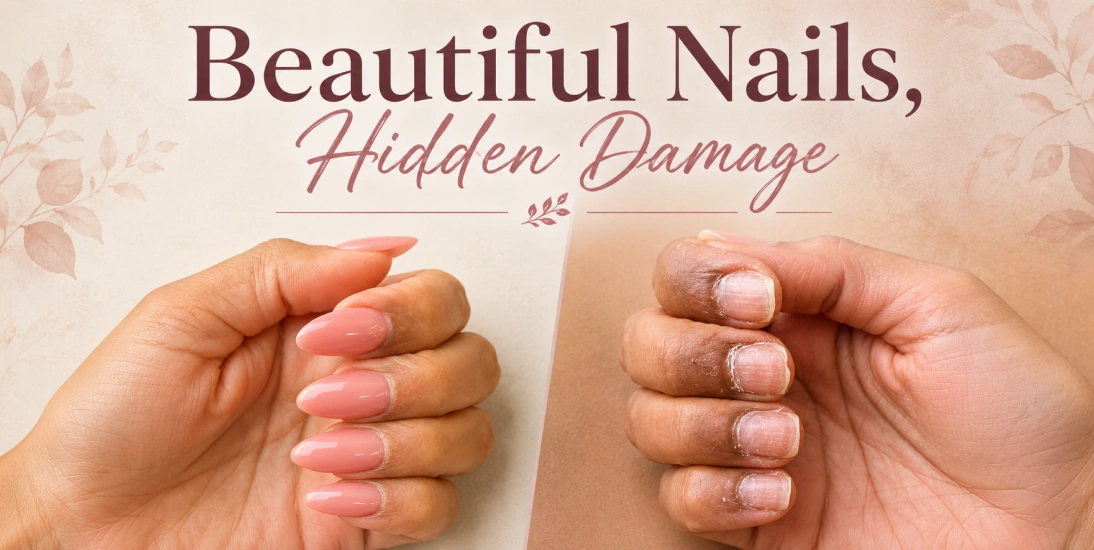

I was traveling to my country and had a photo shoot scheduled, so of course I wanted my hands and nails to look beautiful. I decided to have ceramic-style artificial nails applied. The process took almost two hours, and when they were finished, they looked amazing.
But two weeks later, I decided not to do maintenance. I wanted to remove them.
That was when I saw what had happened underneath.
My natural nails were extremely thin, weak and dry. They hurt. They started breaking over and over again. On some fingers, the nail surface was no longer smooth—it had visible depressions and irregularities.
And then I realized something:
We spend so much time thinking about how our nails look that sometimes we forget that nails are actually part of our body—and they have a function.
Your Nails Are Not Just for Beauty
The visible nail, called the nail plate, is made primarily from tightly packed layers of keratinized cells. Keratin is a strong structural protein also found in our skin and hair.
The nail plate protects the sensitive tissues at the tips of our fingers and toes. It also supports fine movements, helps us pick up small objects and contributes to our sense of touch. Underneath the nail is a highly vascular nail bed, while the nail matrix at the base continuously produces new nail cells.
The nail plate is not one solid piece. It is a laminated keratin structure made from many compact layers. This is exactly why aggressive filing of the top surface can be a problem: every time excessive material is removed, part of that natural structure is removed with it.
And unlike skin, damaged nail does not simply repair itself overnight.
A fingernail grows approximately 3 millimeters per month, and replacing an entire fingernail generally takes around four to six months. That means damage created in one afternoon at the salon may remain visible for months while healthy nail slowly grows from the matrix.
Your Nails Can Give You Clues About Your Health
I love looking at the body as a whole, and nails are another place where the body can give us information.
But this is very important:
A nail change is a clue—not a diagnosis.
Many different conditions can create similar nail changes. Bloodwork, medical history, symptoms and sometimes dermatologic testing are necessary to understand the real cause.
Still, there are changes we should pay attention to.
Thin, brittle, peeling or easily breaking nails can result from repeated water exposure, chemicals, aging and cosmetic procedures. Nutritional deficiencies—particularly iron or zinc deficiency—and some systemic conditions may also contribute.
Spoon-shaped nails, where the center becomes concave, are known as koilonychia and have a strong association with iron deficiency, although there are other possible causes.
Very pale nails may be seen with anemia.
Deep horizontal grooves, called Beau’s lines, indicate that nail growth was temporarily interrupted. This can happen after a significant illness, high fever, severe physical stress, chemotherapy or trauma to the nail matrix.
Small pits or depressions can sometimes occur with psoriasis, alopecia areata and atopic dermatitis.
A nail that begins separating from the nail bed, called onycholysis, can result from trauma—including an aggressive manicure—but can also occur with fungal infection, psoriasis and certain systemic conditions.
Yellow, thickened or crumbling nails may indicate fungal infection. Yellow nails can also occur from nail polish, smoking and, less commonly, systemic disease.
Clubbing, when the tips of the fingers become enlarged and the nails curve downward, deserves investigation because it may occur with certain lung, heart, liver and gastrointestinal diseases.
Half-white or unusual white nails can occasionally be associated with kidney disease, liver disease, low albumin and other systemic conditions.
And one change I never want people to ignore is a new or changing dark vertical streak in a nail. Most dark streaks are not melanoma, but melanoma can develop underneath a nail, and a new or changing pigmented streak should be evaluated by a dermatologist.
Another common myth is that every white spot means calcium deficiency. Usually, small isolated white spots are much more commonly related to minor trauma to the nail matrix than to calcium deficiency.
What About Vitamins and Minerals?
Poor nutrition can absolutely affect nail growth because the matrix constantly needs nutrients to produce new keratin.
Research has associated nail abnormalities with deficiencies involving iron, zinc, protein and several vitamins and micronutrients, but the appearance of the nail alone cannot tell us exactly which nutrient is missing.
This is also why I don’t believe the answer to brittle nails is automatically taking huge amounts of biotin.
True biotin deficiency is uncommon, and evidence supporting routine high-dose vitamin or mineral supplementation in people without a documented deficiency is limited. The better approach is to investigate why the nails became weak in the first place.
What Artificial Nails Can Do to Your Natural Nail
This is exactly where my own experience became interesting.
For acrylic, porcelain/ceramic-style and some other artificial nail systems to adhere well, the technician may roughen or file the natural nail.
According to the American Academy of Dermatology, filing the natural nail surface for acrylic application thins the nail and makes it weaker. Removal may involve additional filing or prolonged acetone exposure, and repeated touch-ups can leave natural nails thin, brittle and dry.
That describes almost exactly what happened to me.
And there are additional concerns.
Gel manicures
Gel manicures can cause brittleness, peeling and cracking, especially when repeated frequently or removed aggressively.
Gel also requires light to cure the product. UV and LED nail lamps both involve ultraviolet exposure, although LED lamps generally expose the hands for a shorter period. Dermatologists recommend protecting the skin with broad-spectrum sunscreen or UV-protective fingerless gloves when gel manicures are performed regularly.
Acrylic, gel and artificial nail chemicals
Many artificial nail systems contain acrylates or methacrylates.
These substances are particularly important because some people can become sensitized and develop allergic contact dermatitis. Symptoms may include itching, redness, swelling, pain, peeling skin or reactions around the fingers—and sometimes the face or eyelids after touching them.
Cutting the cuticle
Your cuticle is not useless skin.
It creates a protective seal between the nail plate and surrounding tissue. Removing or aggressively cutting it can make it easier for bacteria and other microorganisms to enter and cause infection.
Excessive drilling and filing
This is probably the biggest lesson from my experience.
Filing the free edge of a nail is very different from repeatedly drilling or buffing the surface of the natural nail plate.
Too much removal can physically thin the nail, weaken its architecture and potentially traumatize the underlying nail structures. Research on cosmetic nail procedures describes thinning, nail separation, inflammation, allergic reactions and nail dystrophy among possible complications.
Do Nail Chemicals Go Directly into Your Bloodstream?
This is something I wanted to understand better.
The answer is more nuanced than what we sometimes hear on social media.
The nail plate is actually a strong keratin barrier, and it significantly limits the penetration of chemicals. Some substances are capable of passing through the nail depending on their molecular size, formulation and other characteristics, but it is not accurate to say that filing your nail automatically allows dangerous chemicals to pour directly into your bloodstream.
The more established concerns from nail cosmetics are damage to the nail itself, allergic sensitization, irritation, exposure through the surrounding skin, infection and inhalation of certain vapors in poorly ventilated environments. The FDA specifically recommends adequate ventilation when using nail products.
And when we excessively thin the nail, we are unnecessarily compromising a natural protective structure.
So, What Should We Do?
I am not saying that women can never have beautiful nails.
I’m saying we need to rethink what beautiful means.
If your nails are already weak or damaged, give them time without gel, acrylic or extensions.
Keep them relatively short while they recover.
Moisturize the nails and cuticles regularly.
Avoid repeatedly buffing or filing the top of the natural nail.
Use gloves when your hands are frequently exposed to water, cleaning products or chemicals.
Don’t cut the cuticle aggressively.
For a wedding, photo shoot or special event, a temporary press-on nail may sometimes be an alternative to a long-term enhancement—but remember that nail glues can also irritate or cause allergy, so they should be used carefully and removed gently.
And sometimes?
Just wear your own nails.
Healthy, natural nails are beautiful too.
If you have persistent pain, nail lifting, significant depressions, swelling, discoloration, a new dark streak or a nail that continues growing abnormally after a cosmetic procedure, have it evaluated rather than simply covering it again with another artificial nail.
Final Thoughts
My nails looked beautiful for two weeks.
But now I may spend several months waiting for the damaged portion to completely grow out.
For me, that was an important reminder.
We take care of our skin.
We protect our hair.
We think about what we eat.
We invest in our health.
Our nails deserve the same attention.
Nails are not simply a place to put color, gel, acrylic or ceramic material. They are living parts of a complex nail unit that protect our fingers, contribute to touch and can sometimes provide valuable clues about what is happening inside the body.
So, before your next manicure, ask one more question—not only:
“How beautiful will my nails look?”
Ask:
“What is this procedure going to do to my natural nail?”
Because beauty should enhance our body—not damage it.
Sources:
- American Academy of Dermatology — 12 Nail Changes a Dermatologist Should Examine
https://www.aad.org/public/everyday-care/nail-care-secrets/basics/nail-changes-dermatologist-should-examine - American Academy of Dermatology — Artificial Nails: Tips for Reducing Nail Damage
https://www.aad.org/public/everyday-care/nail-care-secrets/basics/pedicures/reduce-artificial-nail-damage - American Academy of Dermatology — Gel Manicures: Tips for Healthy Nails
https://www.aad.org/public/everyday-care/nail-care-secrets/basics/pedicures/gel-manicures - U.S. Food & Drug Administration — Nail Care Products
https://www.fda.gov/cosmetics/cosmetic-products/nail-care-products - NCBI Bookshelf — Anatomy, Nail
https://www.ncbi.nlm.nih.gov/books/NBK513133/ - Cashman MW, Sloan SB. Nutrition and Nail Disease
https://pubmed.ncbi.nlm.nih.gov/20620759/ - Nutrition and Nail Disease — Updated Review
https://pubmed.ncbi.nlm.nih.gov/34785009/ - Nail Cosmetics: A Dermatological Perspective
https://pubmed.ncbi.nlm.nih.gov/30793352/ - Adverse Effects of Do-It-Yourself Nail Cosmetics: A Literature Review
https://pubmed.ncbi.nlm.nih.gov/38835709/ - Safety Assessment for Nail Cosmetics: Systemic Exposure Through the Nail Plate
https://pubmed.ncbi.nlm.nih.gov/38423269/ - American Academy of Dermatology — Nail Fungus: Signs and Symptoms
https://www.aad.org/public/diseases/a-z/nail-fungus-symptoms - American Family Physician — Nail Abnormalities: Clues to Systemic Disease
https://www.aafp.org/pubs/afp/issues/2012/0415/p779.html