
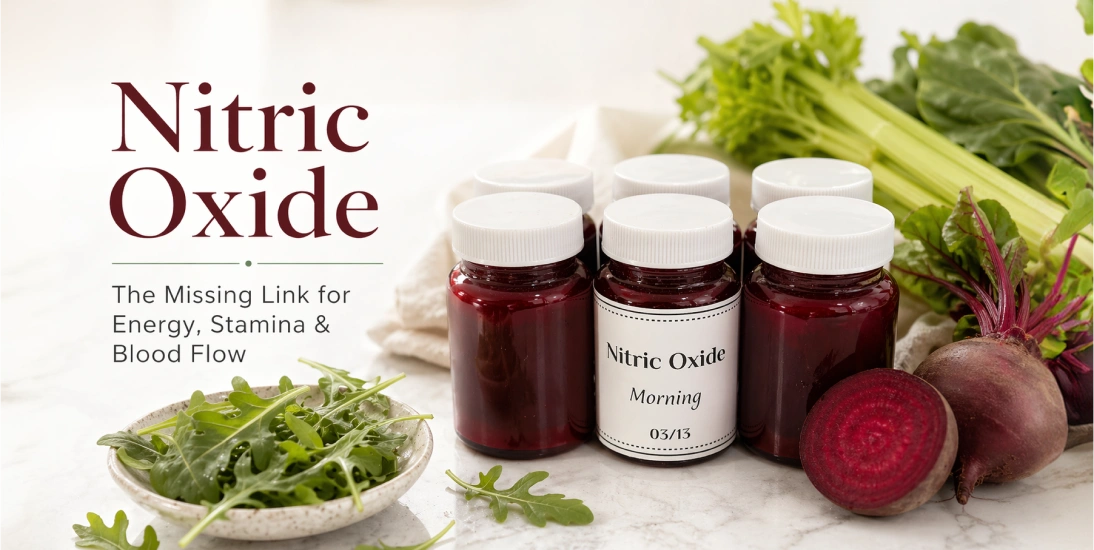



Nitric oxide is a tiny signaling molecule your body makes naturally, and it plays a major role in how well your blood vessels open, how efficiently oxygen gets delivered, how well muscles perform, and how your body responds to exercise. In simple terms, nitric oxide helps blood move better, helps tissues get what they need, and supports the “flow” that makes stamina, performance, and recovery easier. When nitric oxide production is impaired, blood vessels tend to narrow, circulation suffers, and the body becomes less efficient.
Why nitric oxide matters more than most people realize
After the introduction, this is the part that really changed the way I look at food and performance:
As a former chef, I always start with food when I want to support better health. In my protocols, in my way of practicing, I first look for what food can do before I look anywhere else. One of my latest discoveries that truly blew my mind was nitric oxide.
Nitric oxide is not a trendy supplement idea. It is a real physiological messenger involved in vasodilation, meaning it helps relax and widen blood vessels. That matters for circulation, exercise tolerance, oxygen delivery, and cardiovascular health. It also affects platelet activity and the health of the endothelium, the delicate inner lining of your blood vessels. Healthy nitric oxide signaling helps keep arteries open and responsive; low nitric oxide is closely tied to endothelial dysfunction and hypertension.
The symptom is not always “fatigue” — sometimes it is poor flow
A lot of people say they feel “tired,” but what they are really experiencing may be a combination of things:
- reduced exercise tolerance, sluggish circulation, less pump during workouts, poorer stamina, slower recovery, or simply not feeling that the body is performing efficiently.
Nitric oxide helps explain part of that picture. It supports blood flow to working tissues and can improve the efficiency of oxygen use during exercise. Research on dietary nitrate, especially from beetroot juice and leafy greens, suggests it can lower the oxygen cost of submaximal exercise and modestly improve some exercise-performance outcomes, especially in recreational or moderately trained people. The effects are not magic, and they are not identical in everyone, but the physiology is real.
Nitric oxide and energy: what is true and what is oversimplified
People often say nitric oxide is involved in “energy production.” That idea is partly true, but it needs to be explained correctly.
Nitric oxide does not create calories or replace mitochondria. What it does is help regulate vascular tone, oxygen delivery, and aspects of mitochondrial respiration and cellular metabolism. That means nitric oxide can influence how efficiently energy is used and how well oxygen-demanding tissues perform, especially during exercise. So, it is more accurate to say nitric oxide helps support energy efficiency, oxygen use, exercise economy, and tissue perfusion than to say it directly “makes energy.”
Why I like nitric oxide shots in the morning, especially before a workout
This is why I like making nitric oxide-supportive shots and why I often recommend taking them in the morning before exercise.
Morning is a practical time because many people train early, and dietary nitrate-rich foods or shots are often used before workouts to support circulation and exercise efficiency. Beetroot juice, one of the most studied food-based nitric oxide supporters, has been researched for its effects on endurance, oxygen cost, vascular function, and recovery. The strongest evidence is around better blood flow and modest support for exercise performance, not around instant “energy” like caffeine. It is a different kind of support: more circulation, more oxygen delivery, and often a better sense of stamina and output.
The food side of nitric oxide: one of the most exciting parts
One reason nitric oxide is so exciting to me is that food can help support it.
Dietary nitrate from vegetables can be converted in the body through the nitrate → nitrite → nitric oxide pathway. Green leafy vegetables and beetroot are among the best-known sources. Reviews consistently point to leafy greens and root vegetables as meaningful contributors to nitric oxide bioavailability and cardiometabolic support.
The foods most often associated with nitric oxide support include:
- beetroot or beet juice
- arugula
- spinach
- lettuce and other leafy greens
- celery
These foods do not work because they are “stimulating.” They work because they provide compounds your body can turn into more nitric oxide under the right conditions. That is one reason a food-first approach can be so powerful.
One surprising thing that can interfere with nitric oxide
Here is something many people never hear:
Your oral bacteria help convert dietary nitrate into nitrite, which is a key step in making nitric oxide through the dietary pathway. That means the mouth is not just the beginning of digestion; it is part of this nitric oxide story. Some research suggests that disrupting these bacteria, including through strong antiseptic mouthwash use, can reduce nitric oxide production through this pathway and may negatively affect blood pressure responses.
That does not mean nobody should ever use mouthwash. It means nitric oxide biology is more connected, and more fascinating, than most people realize.
What nitric oxide may help support
When nitric oxide production is healthy, it may help support:
- better blood vessel relaxation and circulation
- endothelial health
- healthier blood pressure regulation
- exercise tolerance and stamina
- oxygen delivery to muscles
- possibly better recovery and exercise efficiency
The most consistent research is in vascular function, blood pressure, endothelial health, and exercise physiology. Some broader claims online go much further than the evidence supports, so it is important to stay grounded. Nitric oxide is important, but it is not a cure-all.
The real takeaway
If someone is struggling with low stamina, poor circulation, sluggish workouts, or simply wants to support cardiovascular health in a smarter way, nitric oxide deserves attention.
Not because it is hype.
Because it is basic physiology.
This is one of those topics that reminds us how powerful the body is when given the right support. Healthy blood flow changes everything. Better circulation means better delivery. Better delivery means better performance. And sometimes the first step is not another stimulant, but better vascular function.
That is why nitric oxide has become one of the most interesting things I have been studying and using in a food-first way.
Sources
1. NIH Office of Dietary Supplements
https://ods.od.nih.gov/factsheets/ExerciseAndAthleticPerformance-HealthProfessional/
2. Zoughaib WS, et al. Frontiers in Nutrition, 2024
https://www.frontiersin.org/journals/nutrition/articles/10.3389/fnut.2024.1347242/full
3. Cleveland Clinic — Endothelial Dysfunction
https://my.clevelandclinic.org/health/diseases/23230-endothelial-dysfunction
4. Harvard Health — Exercise and your arteries
https://www.health.harvard.edu/heart-health/exercise-and-your-arteries
5. Bryan NS. Nitric oxide deficiency is a primary driver of hypertension
https://pubmed.ncbi.nlm.nih.gov/36349641/
https://www.sciencedirect.com/science/article/abs/pii/S0006295222004191
6. Olas B. The Cardioprotective Role of Nitrate-Rich Vegetables
https://pmc.ncbi.nlm.nih.gov/articles/PMC10931520/
7. Pinaffi-Langley AC da C, et al. Dietary Nitrate from Plant Foods: A Conditionally Essential Nutrient?
https://pmc.ncbi.nlm.nih.gov/articles/PMC10776916/
8. Morou-Bermúdez E, et al. Pathways Linking Oral Bacteria, Nitric Oxide Metabolism, and Cardiometabolic Health
https://pmc.ncbi.nlm.nih.gov/articles/PMC9124908/
9. Bryan NS. The oral microbiome, nitric oxide and exercise performance
https://pubmed.ncbi.nlm.nih.gov/35636654/
https://www.sciencedirect.com/science/article/pii/S1089860322000544