
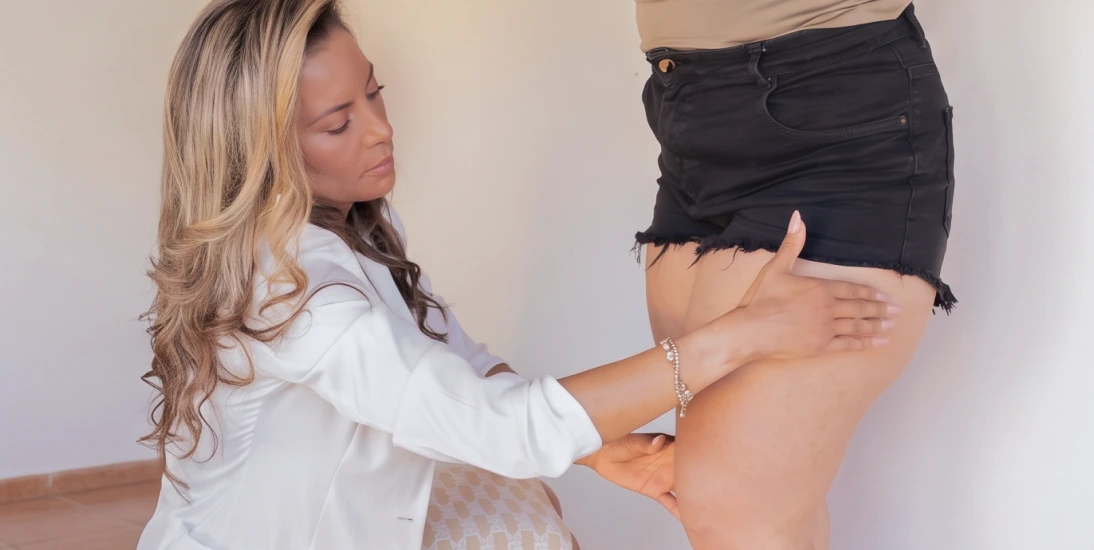



Sometimes the answer is not simply that you need to lose more weight.
It may be lipedema.
And this distinction matters enormously, because lipedema is not just ordinary body fat and it is not simply obesity.
Lipedema is a chronic disorder of adipose and connective tissue characterized by an abnormal, disproportionate and usually symmetrical accumulation of fatty tissue, most commonly in the hips, buttocks, thighs and legs and sometimes in the arms. Pain, tenderness, swelling, heaviness and easy bruising are common. It occurs almost exclusively in women and is still frequently mistaken for obesity or lymphedema.
And because so many women remain undiagnosed for years, understanding the pattern is extremely important.
Lipedema Often Begins Around Hormonal Changes
One of the most interesting characteristics of lipedema is its relationship with a woman’s hormonal life.
It commonly first appears or noticeably worsens around:
- puberty,
- pregnancy,
- perimenopause,
- menopause,
- and sometimes other major hormonal transitions.
This is one reason lipedema can begin surprisingly young.
A girl may enter puberty and suddenly notice that her hips and legs begin becoming much larger in relation to her waist and upper body. Years later she may be told that this is simply her “body shape,” cellulite or weight gain.
But the distribution may actually be the beginning of lipedema.
Current research strongly supports an association with female sex hormones and altered estrogen signaling. Researchers are examining estrogen receptors, adipocyte behavior, inflammatory pathways, fibrosis, vascular permeability and connective-tissue changes.
However, the science is more complex than saying that lipedema is simply caused by high estrogen or estrogen dominance. That has not been established.
The best current model is that hormonal signaling interacts with genetic predisposition, abnormal adipose tissue biology, inflammation, connective-tissue remodeling and vascular/lymphatic dysfunction.
Is It Lipedema or Just Body Fat?
This is where women need to pay attention to their bodies.
Ordinary weight gain tends to increase body fat relatively broadly. When a person loses substantial weight, fat mass usually decreases throughout the body, although genetics certainly determine where we lose it first and last.
Lipedema behaves differently.
A woman may lose weight from her face, breasts, waist and abdomen while her thighs and legs remain disproportionately enlarged.
That does not mean weight management is irrelevant. A woman can have lipedema and obesity simultaneously, and excess weight can make mobility, inflammation and symptoms more difficult.
But obesity and lipedema are not the same disease.
Signs that make me think beyond ordinary body fat
Look at the complete picture rather than one isolated symptom.
Some of the most characteristic signs include:
1. Disproportionately larger lower body
The waist and torso may remain relatively small while the hips, buttocks, thighs and legs become much larger.
2. Both legs are affected
Lipedema is typically bilateral and relatively symmetrical.
One leg being dramatically more swollen than the other should raise suspicion for other vascular or lymphatic conditions and deserves medical evaluation.
3. The feet are often spared
This is one of the most interesting visual clues.
Fat may accumulate all the way down the leg and then appear to stop abruptly around the ankle, producing an ankle “cuff.”
The foot itself remains relatively unaffected, particularly in earlier lipedema.
4. Pain and tenderness
This is extremely important.
Ordinary body fat usually does not hurt when you press it.
Lipedema tissue may be tender, painful or extremely sensitive to pressure.
Some women even describe clothing, massage or someone pressing the leg as uncomfortable.
5. Easy bruising
Lipedema is frequently associated with capillary fragility and easy bruising. A woman may look at her legs and find bruises without remembering any significant injury.
6. Heavy legs
The legs may feel tired, full, pressured or heavy, particularly after spending hours standing.
7. Swelling can increase during the day
Some women feel relatively better in the morning and considerably heavier or more swollen by evening.
8. The tissue feels different
With progression, the subcutaneous tissue can become irregular, nodular and fibrotic.
Under the skin it may feel like tiny grains, peas or eventually larger nodules.
This altered connective-tissue architecture is one reason the surface of the skin can become increasingly irregular.
9. Pronounced cellulite-like appearance
Lipedema and cellulite are not identical conditions.
However, fibrosis, enlarged adipocytes, connective-tissue remodeling and changes in the extracellular matrix can create a pronounced dimpled, uneven appearance.
This is why treating the condition as a purely cosmetic cellulite problem misses what may be happening underneath the skin.
10. Dieting changes the upper body much more than the legs
This is one of the stories I hear that should make us investigate further:
“I lost 20 pounds, but my legs hardly changed.”
Lipedema tissue can be unusually resistant to conventional weight-loss strategies compared with ordinary adipose tissue.
What About the Knees, Feet and the Way a Woman Walks?
Lipedema can also change biomechanics.
When substantial tissue accumulates around the inner thighs and medial knees, the knees can be pushed toward one another while the lower legs and feet remain farther apart.
Some women consequently develop altered gait, knee loading, ankle instability or foot problems.
Orthopedic abnormalities have indeed been described in women with lipedema. But knock-knees or flat feet alone do not diagnose lipedema.
They need to be interpreted together with the characteristic fat distribution, pain, tenderness, bruising and tissue changes.
It Is Not Simply “Extra Fluid”
Another misconception is that lipedema is just fluid retention.
It isn’t.
The primary abnormality involves adipose/connective tissue.
However, the microvascular and lymphatic systems can become involved, and fluid dynamics may contribute to heaviness and swelling. In more advanced disease, secondary lymphedema can coexist with lipedema, producing lipolymphedema.
This is one reason lymphatic health deserves attention—but draining fluid alone does not eliminate pathological lipedema tissue.
Why Inflammation Matters
This is one of the areas that especially interests me from a functional-medicine perspective.
Lipedema tissue demonstrates biological changes involving inflammation, fibrosis, adipocyte dysfunction and connective-tissue remodeling.
Newer research continues to examine how chronic low-grade inflammation may contribute to progression and symptoms. A 2026 study examining dietary inflammatory patterns in women with lipedema found that more pro-inflammatory dietary patterns were associated with greater systemic inflammation.
And this is where I approach the person as a whole.
I don’t look only at the size of her thighs.
I want to know:
What is happening with her gut?
What is happening metabolically?
How is her insulin?
How is she sleeping?
How much inflammatory food is she eating?
How is her lymphatic circulation?
What is happening hormonally?
How much muscle does she have?
What is her stress level?
Is she constipated?
Is she consuming enough omega-3 fats, fiber, polyphenols and micronutrients?
Because even when we cannot change someone’s genetics, we can work on the environment in which those genes and tissues are functioning.
My Functional-Medicine Approach: I Start with the Gut
In my functional-medicine protocols, the gut is one of the first systems I investigate.
Why?
Because the intestinal microbiome and intestinal barrier participate in immune regulation, metabolic signaling and systemic inflammation.
Research connecting the gut specifically to lipedema is still emerging; we cannot yet say that “leaky gut causes lipedema.”
But the broader gut-inflammation connection is well established, and microbiome/barrier dysfunction is an active area of investigation in inflammatory and metabolic disease.
Dr. Mark Hyman frequently describes the gut microbiome and intestinal barrier as central components of metabolic and immune health. He also emphasizes supporting lymphatic function through movement, hydration, polyphenol-rich foods, breathing and massage. These are general functional-medicine principles rather than a specific Hyman lipedema treatment protocol.
That distinction is important.
Food Becomes Part of the Treatment Environment
My objective is not simply:
“Eat less.”
It is:
Lower the inflammatory burden of the diet while nourishing the body exceptionally well.
I favor a Mediterranean-style, whole-food pattern rich in:
- vegetables of many colors,
- leafy greens,
- berries,
- extra-virgin olive oil,
- avocado,
- herbs and spices,
- adequate clean protein,
- omega-3-rich fish,
- nuts and seeds when tolerated,
- high-fiber plant foods,
- and polyphenol-rich foods.
And I dramatically reduce ultra-processed foods, refined sugar, fried foods, processed oils and excessive refined carbohydrates.
The Mediterranean diet is one of the strongest dietary patterns available for cardiometabolic and inflammatory health, and emerging lipedema research also favors reducing the overall inflammatory character of the diet.
What About Gluten, Sugar and Dairy?
In my lipedema protocols, I focus on eliminating gluten, added sugar and dairy during the initial phase because these foods can act as inflammatory triggers in susceptible individuals and may contribute to gut-barrier dysfunction.
When intestinal permeability increases—often called “leaky gut”—microbial products and other compounds can cross the gut barrier more easily and stimulate immune and inflammatory pathways.
That is one reason I start with the gut.
My goal is not to say that gluten or dairy cause lipedema, but to reduce potential inflammatory triggers while supporting the microbiome, digestion and intestinal barrier.
Dr. Patricia Mills uses a similar functional-medicine approach, emphasizing gut health, elimination of individual inflammatory triggers, whole foods, hormone balance and systematic food reintroduction.
For me, reducing inflammation from the inside is an important part of creating a healthier environment for a woman with lipedema.
Supporting the Lymphatic System
Movement is medicine here.
Muscle contraction acts as an important mechanical pump supporting venous and lymphatic return.
Depending upon the woman’s mobility and pain, useful options may include:
- walking,
- resistance training,
- swimming,
- aquatic exercise,
- cycling,
- mobility work,
- diaphragmatic breathing,
- and individualized low-impact exercise.
Exercise studies in women with lipedema suggest benefits for physical function and symptom management, particularly when incorporated with other conservative therapies.
Compression therapy and appropriately performed manual lymphatic drainage may also form part of conservative management, particularly when swelling and lymphatic impairment are present.
And I love another tool because it is simple:
massage.
For some women, gentle leg massage can provide a feeling of lightness, relaxation and comfort.
However, aggressive painful massage is not my objective. Lipedema tissue may already be tender and prone to bruising.
Essential Oils: Useful for the Massage Experience, Not a Cure
Essential oils are often promoted online as if eucalyptus, grapefruit, cypress or another oil can “drain the lymph.”
That goes beyond the clinical evidence.
We currently do not have strong trials showing that an essential oil removes lipedema fat or meaningfully treats the underlying disease.
I therefore use essential oils differently:
as an adjunct to massage, for relaxation, sensory comfort and the ritual of self-care—not as the active treatment for lipedema.
Lavender is one of the better-studied aromatherapy oils for relaxation and comfort, although again, that evidence should not be confused with evidence of lipedema treatment.
Essential oils should always be adequately diluted in a carrier oil and should not be applied undiluted to large areas of skin.
And What About Peptides?
This is where regenerative and functional medicine becomes extremely interesting—but also where we need to distinguish mechanistic potential from established lipedema therapy.
At present, there is no peptide therapy proven in controlled clinical trials to treat lipedema itself.
That is very important.
However, some peptides being investigated in regenerative medicine influence pathways that interest me when I am working on the overall inflammatory environment.
BPC-157
BPC-157 has demonstrated effects involving gastrointestinal tissue protection, wound healing, inflammatory pathways and vascular biology in experimental research.
This is one reason it has attracted so much interest when gut integrity and tissue repair are part of the objective.
But most of the published evidence remains preclinical, and BPC-157 has not been established as a lipedema treatment in human clinical trials.
KPV
KPV is a small tripeptide derived from the melanocortin pathway.
Experimental studies are particularly interesting because KPV has demonstrated anti-inflammatory effects in models of intestinal inflammation and colitis.
That makes KPV scientifically intriguing from a gut-inflammation perspective.
Again, that is very different from saying that KPV has been proven to treat lipedema. It hasn’t.
GHK-Cu
GHK-Cu interests me from a completely different angle.
GHK-Cu has been studied for:
- tissue remodeling,
- collagen synthesis,
- elastin,
- wound healing,
- antioxidant activity,
- and inflammatory signaling.
Research has demonstrated effects on collagen and extracellular-matrix remodeling and improvements in several measures of aging skin.
Since lipedema involves much more than superficial cellulite, I would never call GHK-Cu a “cellulite treatment.”
But when a woman’s broader protocol includes skin quality and connective-tissue support, GHK-Cu is an interesting regenerative peptide to follow scientifically.
My Approach Is Not About One Supplement, One Peptide or One Massage
This is probably the most important message.
Lipedema is not solved by finding one magic treatment.
I look at several systems simultaneously.
Gut.
Inflammation.
Nutrition.
Hormonal environment.
Muscle.
Movement.
Lymphatic circulation.
Connective tissue.
Metabolic health.
Stress.
Sleep.
Then I build the strategy around the individual woman.
Food may be used to lower her inflammatory dietary burden.
Certain supplements may support nutritional deficiencies, antioxidant status, bowel function or metabolic health when indicated.
Movement maintains muscle and improves the mechanical pumping of fluid.
Massage and lymphatic strategies may reduce heaviness and improve comfort.
Compression may be appropriate.
And selected regenerative therapies may be considered for specific goals—but should never be presented as proven cures when the human evidence has not reached that point.
What Should You Avoid?
If I suspect lipedema, the things I most want to avoid are not only foods.
I want to avoid:
Crash dieting.
A woman can lose tremendous weight from her upper body, lose muscle and become metabolically weaker while remaining disproportionately enlarged through her lower body.
Muscle loss.
Strong muscle is enormously important for mobility, metabolic health and circulation.
An ultra-processed diet.
Reducing refined sugar and highly processed foods is one of the most sensible nutritional interventions for controlling overall metabolic and inflammatory load.
A sedentary lifestyle.
Not moving because your legs hurt can create a vicious cycle of reduced muscle pumping, diminished conditioning and worsening mobility.
Ignoring pain and bruising.
Painful fatty tissue is not something a woman should automatically dismiss as cellulite.
And perhaps most importantly:
Avoid assuming that every woman with large legs simply needs to lose weight.
The Question Is Not Just “How Much Fat Do You Have?”
It is:
Where is the fat?
How does the tissue feel?
Does it hurt?
Do you bruise easily?
Are the feet spared?
Is it symmetrical?
When did it begin?
Did it change around puberty, pregnancy or menopause?
And what happens to your legs when you lose weight?
Those questions can completely change the conversation.
Lipedema is still underdiagnosed.
And many women who have spent decades fighting their bodies may actually need something very different from another restrictive diet.
They need someone to recognize the pattern.
Because when we understand what the body is telling us, we can stop treating everything as simply “extra body fat” and start building a much more intelligent, individualized strategy.
That is the difference between chasing a number on the scale and understanding the physiology behind the body.
Final Thought
Lipedema is not simply “stubborn fat,” and it should never be treated as if the only solution is to eat less and exercise more.
When we understand that lipedema can involve hormonal changes, inflammation, connective tissue, circulation, lymphatic function and metabolic health, the approach becomes much more complete.
For me, the goal is always to look beyond the legs and understand what is happening inside the body. That means supporting the gut, reducing inflammatory triggers, improving nutrition, protecting muscle, encouraging movement and lymphatic flow, and individualizing supplements and other therapies when appropriate.
There is no single magic treatment. But when we address the body as a whole, we can work toward reducing heaviness, discomfort and inflammation while improving mobility, body composition and quality of life.
Most importantly, women need to know that if their legs are painful, disproportionate, bruise easily and do not respond to weight loss the way the rest of the body does, it may be more than body fat—and it deserves to be properly investigated.
Sources
1. Lipedema World Alliance Delphi Consensus-Based Position Paper — Nature Communications, 2026
International consensus on lipedema definition, signs, diagnosis, and management.
https://www.nature.com/articles/s41467-025-68232-z
2. Lipedema: Clinical Features, Diagnosis, and Management — 2025 Review
Covers symptoms, diagnosis, and differences between lipedema, obesity, and lymphedema.
https://pmc.ncbi.nlm.nih.gov/articles/PMC12081092/
3. Lipedema: Progress, Challenges, and the Road Ahead — 2025
Reviews pain, bruising, nodular tissue, fat distribution, and current research.
https://pmc.ncbi.nlm.nih.gov/articles/PMC12404891/
4. Lipedema: An Overview of Its Clinical Manifestations, Diagnosis and Treatment
Clinical overview of symmetrical fat accumulation, pain, bruising, and female predominance.
https://pubmed.ncbi.nlm.nih.gov/25586162/
5. Cause and Management of Lipedema-Associated Pain
Focuses on pain, tenderness, fat distribution, and characteristic sparing of the feet.
https://pubmed.ncbi.nlm.nih.gov/33001552/
6. Prevalence of Clinical Manifestations and Orthopedic Alterations in Patients With Lipedema
Supports discussion of knee, gait, mobility, and orthopedic changes.
https://pubmed.ncbi.nlm.nih.gov/35073621/
7. Herbst KL, et al. Standard of Care for Lipedema in the United States
U.S. clinical guidance on diagnosis, symptoms, lymphatic involvement, and treatment.
https://pmc.ncbi.nlm.nih.gov/articles/PMC8652358/
8. Cleveland Clinic — Lipedema: Causes, Symptoms & Treatment
Patient-friendly overview of symptoms, progression, nodules, pain, bruising, and mobility.
https://my.clevelandclinic.org/health/diseases/17175-lipedema
9. Dr. Patricia Mills — Anti-Inflammatory Diet
Discusses reducing inflammatory dietary triggers and supporting gut health.
https://drpatriciamills.com/reduce-inflammation-naturally-with-the-anti-inflammatory-diet/
10. Di Vincenzo F, et al. Gut Microbiota, Intestinal Permeability, and Systemic Inflammation
Explains the relationship between gut-barrier dysfunction and systemic inflammation.
https://pubmed.ncbi.nlm.nih.gov/37505311/
11. Arnone D, et al. Sugars and Gastrointestinal Health
Reviews how excessive sugar intake may affect the microbiome and intestinal barrier.
https://pubmed.ncbi.nlm.nih.gov/34902573/
12. Barbaro MR, et al. Non-Celiac Gluten Sensitivity in the Context of Functional Gastrointestinal Disorders
Reviews gluten/wheat sensitivity, gut-barrier function, and immune activation.
https://pubmed.ncbi.nlm.nih.gov/33291590/